

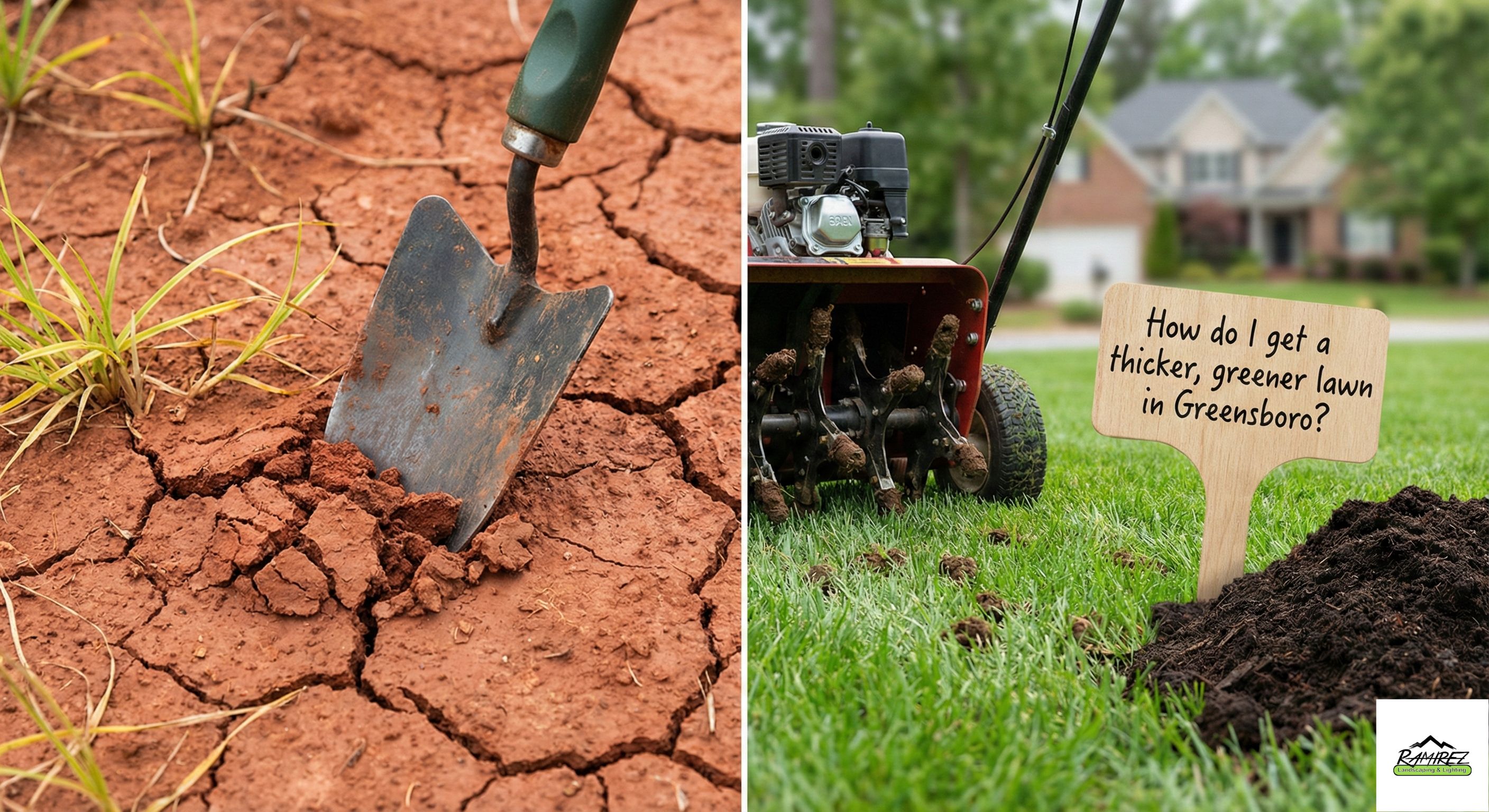
How do I get a thicker, greener lawn in Greensboro?

Get a FREE Design Consultation! ($500 Value - Limited Time)
Get in touch for a free consultation and estimate

The secret to achieving a thick, vibrantly green lawn in Greensboro isn't found in a bag of fertilizer or a complex watering schedule. It's a foundational strategy focused on conquering our region's notorious red Piedmont clay soil. By transforming this compacted, nutrient-poor barrier into a healthy, living foundation, you enable the deep root growth necessary for a lush, resilient turf that can truly thrive in the North Carolina climate.
The Hidden Enemy: Why Greensboro's Piedmont Clay is the Secret Villain of Your Lawn
If you've ever tried to dig a hole in your yard, you already know the challenge. That dense, reddish-brown clay is the defining characteristic of our landscape in the Piedmont Triad. For many homeowners from Summerfield to Sedgefield, this soil is the primary, often unrecognized, reason for their lawn care frustrations. It’s the source of thin, patchy turf, persistent weeds, and that frustrating yellow or brown hue that appears with the first sign of summer stress.
What makes this specific soil type so difficult? It comes down to its physical structure. Clay particles are incredibly fine and pack together tightly, leading to several problems that directly impact the health of your grass. As a resource from landscaping experts explains, clay soil is dense, retains water, and lacks the nutrients and air circulation needed to support plant growth and health. This creates a cascade of issues:
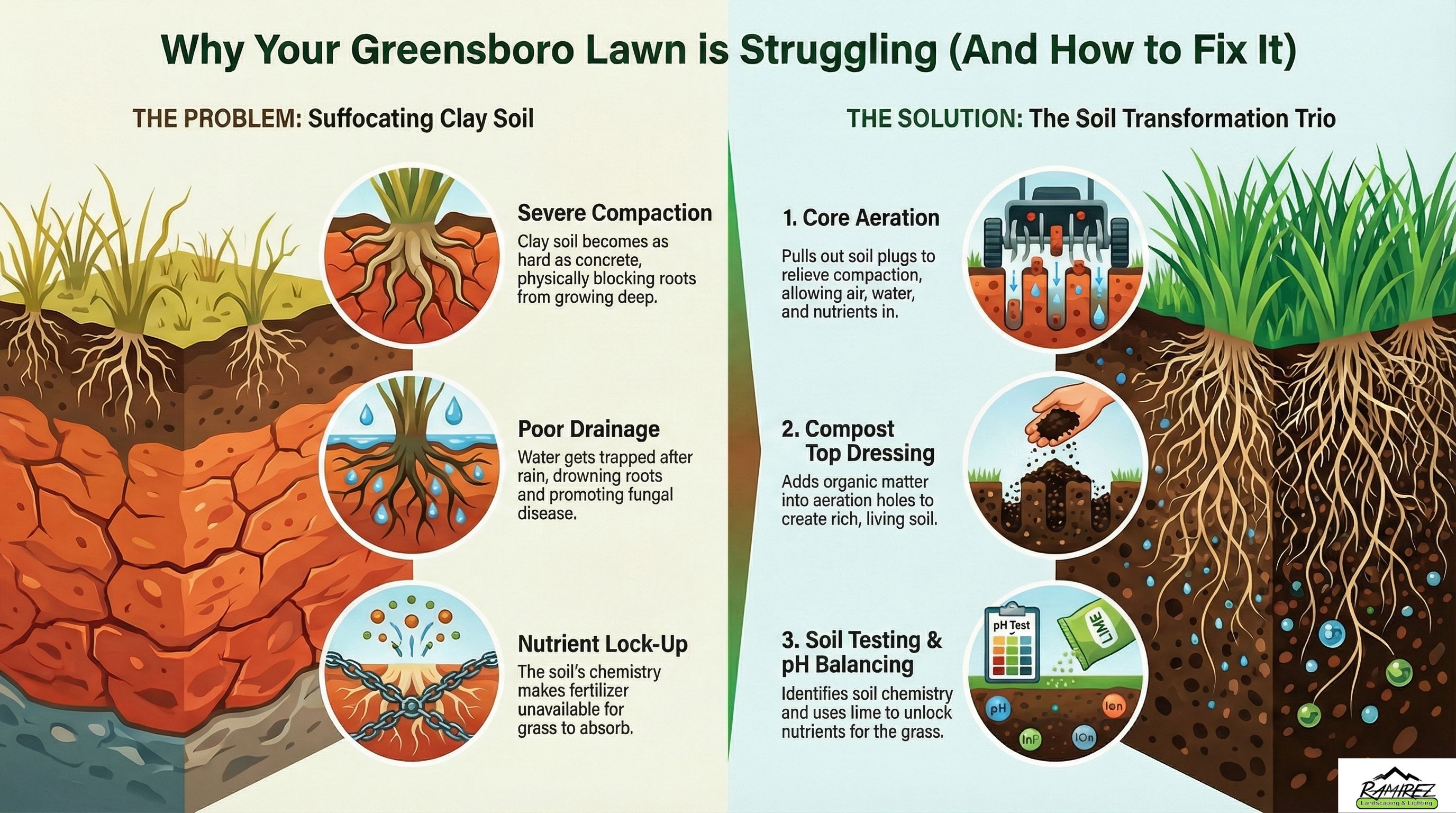
- Severe Compaction: Over time, from foot traffic, mowing, and even heavy Greensboro rainstorms, clay soil becomes as hard as concrete. This compaction physically blocks grass roots from growing deeper than a few inches, preventing them from accessing moisture and nutrients stored further down in the soil profile.
- Poor Drainage: While clay holds water, it doesn't let it drain through. This leads to a waterlogged root zone after rain, starving the roots of essential oxygen. This is a key reason for many signs of unhealthy lawn soil, like root rot and fungal diseases that thrive in damp, stagnant conditions. Learning how to improve lawn drainage in clay soil is fundamental to lawn success here.
- Nutrient Lock-Up: The dense nature of clay and its typical pH level in North Carolina can "lock up" essential nutrients, making them unavailable to the grass plants even if you apply fertilizer. Your efforts to feed your lawn are wasted because the nutrients can't reach the roots. This is often why a Greensboro lawn is turning yellow despite regular fertilization.
When you see a lawn with bare patches where nothing seems to grow, or grass that wilts at the first sign of a hot July afternoon, the culprit isn't necessarily a lack of water or fertilizer. The true villain is the compacted, lifeless clay soil suffocating the life out of your turf.
Beyond Surface-Level Fixes: The Cycle of Wasted Time and Money
Every spring, homeowners across Greensboro head to the store with the best intentions. They buy premium grass seed, apply bags of high-nitrogen fertilizer, and set their sprinklers on a timer, hoping this will be the year they achieve that perfect, green yard. Unfortunately, when applied to untreated Piedmont clay, these efforts are often a significant waste of time and money.
Think of it this way: spreading seed and fertilizer on top of compacted clay is like trying to grow a garden on a paved driveway. It's a surface-level fix for a foundational problem. The results are predictably poor:
- Seed Fails to Germinate: Grass seed needs good seed-to-soil contact to germinate. As one horticultural guide notes, hard, compacted ground can prevent grass seeds from penetrating the soil and successfully rooting. The seeds simply sit on the surface, where they are washed away by the next rain or eaten by birds.
- Roots Can't Penetrate: For the few seeds that do manage to sprout, their struggle is just beginning. The new, tender roots hit the wall of compacted clay and can't grow downward. This results in a shallow-rooted lawn that is incredibly vulnerable to heat and drought stress.
- Fertilizer Runoff: When you spread fertilizer on dense, non-porous soil, much of it is washed away into storm drains by rain or irrigation before it ever has a chance to be absorbed. This not only wastes your money but also contributes to nutrient pollution in our local Greensboro waterways.
This is the frustrating cycle so many experience. They invest in products, see minimal or short-lived results, and blame the grass type or the weather. The truth is, without first addressing the soil's structure, you're building your lawn on a foundation of failure. A professional lawn fertilization service in Greensboro that doesn't first talk about your soil health is only addressing a symptom, not the core disease.
Long-Term Soil Health vs. Short-Term Topical Fixes: A Greensboro Homeowner's Comparison
Understanding the difference between a foundational soil strategy and superficial treatments is the most important step toward achieving a lush green lawn in the Piedmont Triad. Here’s a breakdown of the two approaches and the key decision factors to consider.
Key Factor: Underlying Soil Composition (Clay, Compaction, pH)
Foundational Soil Health Strategy: Directly targets and permanently alters the poor structure of Greensboro's clay soil. It focuses on relieving compaction, improving drainage, and balancing pH to create a hospitable environment for root growth. This is the core of any effective Greensboro lawn renovation service.
Superficial Treatments: Ignores the underlying soil condition. It attempts to force growth on the surface with chemical inputs, which are often inefficiently absorbed due to compaction and improper pH. This leads to a dependent lawn that struggles without constant inputs.
Key Factor: Deep Root Growth and Lawn Resilience
Foundational Soil Health Strategy: By breaking up compaction and adding organic matter, this approach enables roots to grow deep into the soil profile—6 inches or more. Deep roots can access more water and nutrients, creating a resilient turf that can withstand Greensboro's scorching summer heat and periods of drought with less irrigation.
Superficial Treatments: Frequent, shallow watering and surface-level feeding encourage a shallow, weak root system. These lawns look good in the mild weather of spring but quickly turn brown and stressed during summer because their roots can't reach deeper, cooler moisture in the soil.
Key Factor: Long-Term Results vs. Short-Term Gains
Foundational Soil Health Strategy: This is an investment that pays dividends for years. Once the soil structure is improved, your lawn becomes more self-sufficient, requiring less water, less fertilizer, and less intervention over time. The cost of lawn care in Greensboro becomes lower in the long run as the lawn becomes healthier. This is the secret to getting a golf course quality lawn in Greensboro.
Superficial Treatments: This approach often provides a quick "green-up" that looks impressive for a few weeks but fades quickly. It creates a dependency on chemical treatments and frequent watering, leading to a constant, and often escalating, investment of time and money each season.
The Soil Transformation Trio: Your Action Plan for a Thriving Greensboro Lawn
Conquering Piedmont clay and building a truly healthy lawn isn't about a single secret product. It's about a systematic approach—a trio of services that work together to fundamentally change the ground beneath your grass. For any Greensboro lawn, these three steps are the non-negotiable starting point for long-term success. At Ramirez Landscaping & Lighting, our customized lawn care programs Greensboro are built on this very foundation.
1. Core Aeration: Giving Your Soil Room to Breathe
Core aeration is the single most important mechanical process for improving clay soil. A professional aerator machine pulls up thousands of small plugs of soil, about 2-3 inches deep, from the lawn. This isn't just "poking holes"; it has profound benefits. The process directly alleviates compaction, allowing vital air, water, and nutrients to penetrate the root zone. These channels give roots a path to grow deeper and stronger. After aeration, the soil plugs left on the surface break down over a couple of weeks, recycling nutrients back into the soil.
Some people ask about liquid aeration vs core aeration for Greensboro soil. While liquid products can help soften the soil, they are not a substitute for the physical de-compaction that mechanical core aeration provides for our dense clay. For a true transformation, core aeration is the superior choice. The best time for this service, often combined with overseeding, is in the fall. Many homeowners look for fall aeration and seeding Greensboro deals between September and November.
2. Compost Top Dressing: The Key to Building Living Soil
After core aeration has opened up the soil, the next step is to introduce organic matter. This is where top dressing the lawn with compost in Greensboro comes in. We spread a thin, high-quality layer of nutrient-rich compost across the entire lawn. The compost falls into the aeration holes and works its way down into the soil profile over time.
This process is transformative. Compost inoculates the sterile clay with beneficial microbes, improves soil structure, increases water retention, and provides a slow-release source of natural nutrients. It's the most effective of all lawn soil amendment services in the Triad area because it turns dense clay into a richer, more loam-like soil. This is the cornerstone of any organic lawn care Greensboro NC program and is far more effective long-term than synthetic fertilizers alone.
3. Soil Testing and pH Balancing: Unlocking Your Lawn's Potential
The final piece of the puzzle is understanding your soil's chemistry. Piedmont clay is naturally acidic, which, as we mentioned, limits the availability of key nutrients. Without correcting the pH, much of your fertilizer investment is wasted. That's why professional soil testing in Greensboro NC is so critical.
As the North Carolina Department of Agriculture states, a soil test measures soil pH, humic matter, and exchangeable acidity to determine if lime is needed and how much to apply. By sending a sample to a lab, we get a precise roadmap for what your specific soil needs. Based on these results, a calculated application of lime can raise the soil pH to the optimal range for turfgrass (typically 6.0 to 7.0). This simple step "unlocks" existing and applied nutrients, making them available to your grass. The best time to apply lime to lawn in NC is typically in the fall or winter, allowing it time to work into the soil before the spring growing season. To maintain optimal conditions, the NCDA&CS also advises that as a general rule, clay soils should be tested every 3 to 4 years to monitor their condition.
Building on the Foundation: A Lawn Maintenance Schedule for the Triad
Once you've addressed the soil, your regular maintenance practices become far more effective. A proper lawn care calendar for Greensboro North Carolina focuses on supporting deep root growth and overall plant health. Here's a look at the seasonal priorities for our region's cool-season grasses like Tall Fescue, which is the most common choice for achieving a thick green yard in our area.
Early Spring (March - April)
This is the time for a spring lawn startup in Greensboro NC. The focus is on preventing summer weeds and providing a gentle feeding. A crucial step is the pre-emergent herbicide application timing in Greensboro. Applying this product before soil temperatures consistently reach 55°F prevents crabgrass seeds from germinating. This is the cornerstone of effective crabgrass control in Greensboro NC. Follow this with a light, balanced fertilizer application to help the turf wake up from dormancy.
Late Spring to Summer (May - August)
Greensboro's summer is a time of stress for cool-season turf like Fescue. Proper watering and mowing are critical for survival.
- Watering: The goal is deep, infrequent watering. You want to encourage roots to chase water downward. According to the NC DEQ, the best watering practices aim to moisten the soil 4-6 inches deep, the extent of the root zone, which requires about 1 inch of water for clay soils. This usually means watering once or twice a week for a longer duration, rather than a short sprinkle every day. Constant, shallow watering is a major mistake, as it promotes shallow roots, which can damage a lawn during times of stress.
- Mowing: Mow high, at 3.5 to 4 inches. The longer grass blades provide shade for the soil, keeping it cooler and reducing water evaporation. It also helps the plant produce more energy through photosynthesis.
Some homeowners with full sun might have warm-season grasses. Zoysia grass care in Greensboro or Bermuda grass maintenance NC follows a different schedule, with more aggressive fertilization during these summer months when they are actively growing.
Fall (September - November)
Fall is the most important season for your Greensboro lawn. This is the prime time for the "Soil Transformation Trio": core aeration, compost top dressing, and overseeding. The cooler temperatures and consistent moisture are ideal for germinating new seed and thickening a Tall Fescue lawn. This is the best time to plant grass seed in Greensboro. A fall fertilization focuses on root development, preparing the grass for winter and ensuring a quick green-up the following spring.
Winter (December - February)
Winter lawn care for Greensboro NC is mostly about preparation and cleanup. Keep leaves off the turf to prevent matting and disease. This is also an excellent time to apply lime if your soil test indicated a need, giving it plenty of time to work. Avoid heavy foot traffic when the ground is frozen or saturated to prevent compaction.
Answering Your Common Greensboro Lawn Care Questions
As local lawn care experts in Greensboro, we hear a lot of the same questions from homeowners. Here are clear, straightforward answers to some of the most common ones.
How to make your lawn thicker and greener?
The key is to shift your focus from the grass blades to the soil beneath. The single most effective strategy for our region is to systematically improve the native Piedmont clay through a combination of annual core aeration, top dressing with compost, and regular soil testing to balance pH with lime. This creates a foundation for deep roots, which is the true secret to a thick, green, and resilient lawn that requires less water and fertilizer over time.
Is October too late to fertilize a lawn?
No, October is actually an excellent time to fertilize a cool-season lawn (like Tall Fescue) in Greensboro. Fall fertilization is geared toward promoting root growth, not excessive top growth. A fall feeding helps the grass store nutrients for the winter, leading to better winter survival and a stronger, faster green-up in the spring. For our area, fertilizing between September and November is ideal.
Does frequent mowing thicken grass?
Yes, to an extent. Mowing correctly does encourage grass plants to grow laterally and become denser. The key is to never remove more than one-third of the grass blade at a single time. Mowing high (3.5-4 inches) and frequently is much better for the turf's health than letting it get overgrown and then cutting it very short. This regular "tipping" stimulates the plant to produce new shoots, known as tillers, which helps in thickening the turf.
Does Epsom salt make grass greener?
Epsom salt (magnesium sulfate) can make grass greener, but only if the lawn has a specific magnesium deficiency. This is very rare in Greensboro's clay soil. Applying it without a soil test confirming a deficiency will not help and can even be detrimental over time by altering soil chemistry unnecessarily. The vibrant green color people sometimes see is a short-term foliage effect, not a long-term solution. A balanced fertilizer designed for turfgrass is always a better and safer choice.
Making the Right Choice for Your Needs
Deciding on the best path forward for your yard depends on your past experiences, your property's specific challenges, and your long-term goals. There is no single "best" lawn service in Greensboro, only the right approach for your unique situation.
For the Frustrated Homeowner who has tried various fertilizers and watering schedules with poor results:
Your frustration is completely understandable, and it almost certainly points to an underlying soil issue. You've been treating the symptoms. It's time to address the root cause. Your best next step is to invest in a foundational soil analysis and improvement plan. Start with a professional soil test and a core aeration service this fall. This will give you a clear diagnosis and begin the physical process of breaking the cycle of failure. The results won't be instantaneous like a chemical spray, but they will be lasting.
For the New Construction Homeowner dealing with a yard of compacted clay left by builders:
You are starting with a clean slate but also the toughest conditions. The "soil" around a new home is often heavily compacted subsoil with all the topsoil scraped away. Do not waste money on seed and straw until you have aggressively addressed this compaction. Your priority should be a comprehensive Greensboro lawn renovation service that includes deep core aeration and a heavy application of compost top dressing. This is a significant upfront investment, but it's the only way to build a healthy soil profile from scratch and avoid years of lawn problems.
For the Proactive Researcher seeking to understand the science behind lawn care in the Piedmont region before investing time and money:
Your desire to understand the "why" is your greatest asset. Continue to focus on the principles of soil science. Your best approach is to start with data: get a soil test from the NCDA&CS. This affordable service will provide a wealth of information about your soil's pH and nutrient levels. Use that report to guide your next steps. You are the perfect candidate for a DIY lawn care program for North Carolina, but one that begins with the foundational principles of aeration and soil amendment, not just a generic 4-step fertilizer program from a big-box store.
Ultimately, transforming a struggling Greensboro lawn into a source of pride begins with a commitment to building a healthy soil foundation. While surface treatments offer a temporary fix, the long-term resilience and beauty of your turf are directly tied to the living, breathing ecosystem beneath your feet. By focusing on alleviating compaction, adding organic matter, and balancing soil chemistry, you create the conditions for a lawn that not only survives but truly thrives in our unique Piedmont climate.
At Ramirez Landscaping & Lighting, we have spent over 15 years developing customized lawn care programs specifically for the challenges of Greensboro's clay soil. Our team of local lawn care experts is ready to help you move beyond the cycle of frustration. For a personalized assessment of your lawn's soil health and a free, no-obligation quote on our Greensboro turf management services, contact our team today. Let us help you build the beautiful, healthy lawn you've always wanted.