

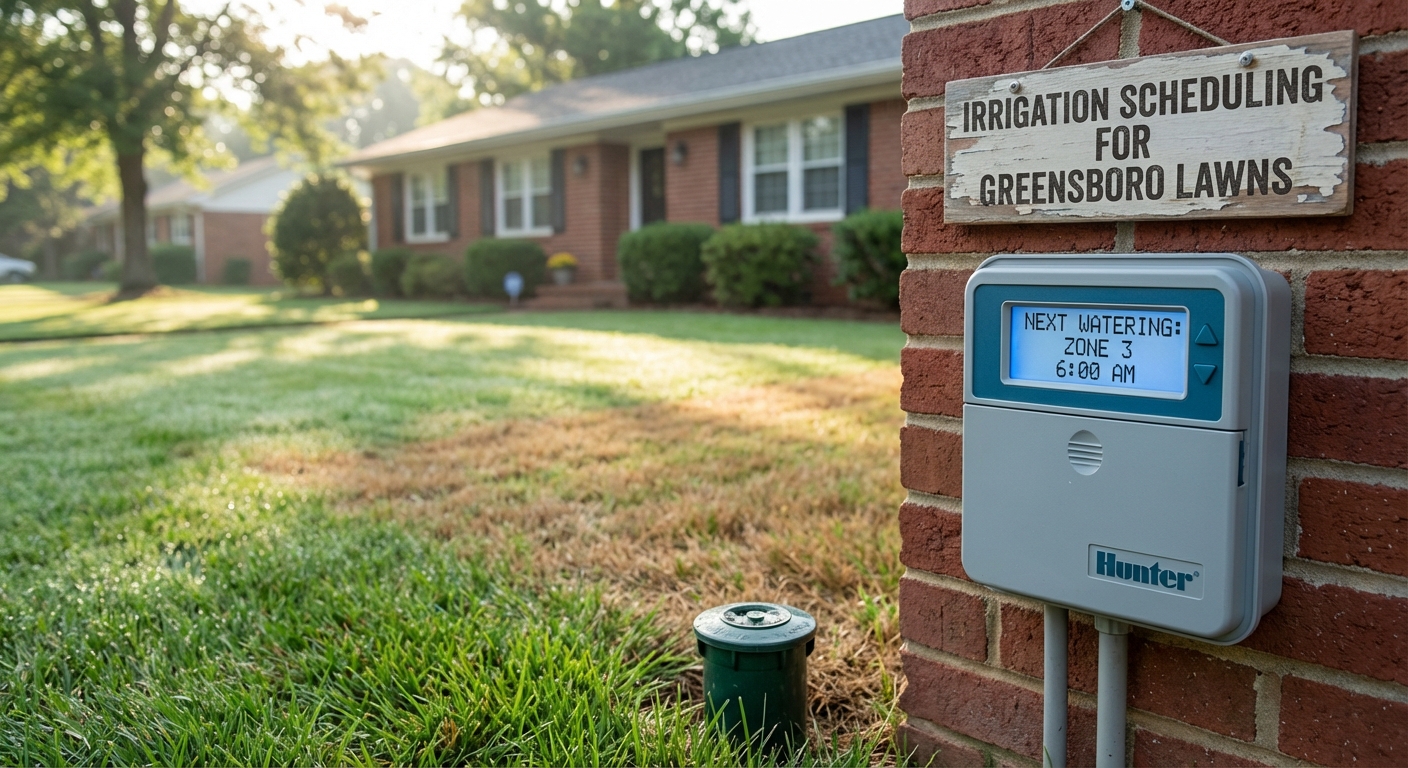
Irrigation Scheduling for Greensboro Lawns

Get a FREE Design Consultation! ($500 Value - Limited Time)
Get in touch for a free consultation and estimate

Quick Summary
- Irrigation scheduling is the process of setting when, how long, and how often each zone in your sprinkler or drip system runs. Getting it right cuts water bills and prevents turf disease.
- Guilford County's red clay requires "cycle and soak" programming. Standard schedules designed for sandy or loam soil cause runoff, not root-zone saturation.
- Warm-season grasses (bermuda, zoysia) and cool-season grasses (tall fescue) need opposite watering frequencies in opposite seasons. Most Greensboro lawns have both.
- A properly calibrated controller, a rain sensor, and optional soil moisture sensors handle 90% of scheduling decisions automatically.
Irrigation scheduling is the set of instructions that tells your irrigation controller when to run each zone, for how long, and how many times per week. A factory-default schedule running every zone 10 minutes three times a week, year-round regardless of rain or season, wastes water and damages turf. Calibrating your schedule to Guilford County soil, grass type, and season is the entire task.
This guide covers practical scheduling rules for the Piedmont Triad, answers the most-asked questions about automatic irrigation systems, and identifies when professional irrigation maintenance produces a measurable return.
Why Greensboro's Clay Soil Changes Everything About Your Watering Schedule
Most irrigation scheduling guides assume sandy or loam soil. They do not apply in Guilford County.
The Piedmont Triad sits on heavy red clay. Clay absorbs water slowly and holds it long after a watering cycle ends. A zone that delivers water faster than the clay can absorb it produces runoff, not root-zone saturation. That runoff carries fertilizer away, erodes planting beds, and provides no benefit to your lawn.
Cycle and soak programming solves this problem. Instead of running each zone in one long interval, split the runtime into two or three shorter cycles with a 30 to 60 minute gap between them. A zone that normally runs 12 minutes becomes two 6-minute cycles. The clay absorbs the first pass before the second arrives.
USDA Hardiness Zone 7b/8a conditions in Greensboro add a second variable: hot, humid summers with periodic drought push evapotranspiration rates up sharply in July and August, then drop significantly in October. A schedule calibrated in April is already wrong by midsummer.
Warm-Season vs. Cool-Season Grass: How Scheduling Splits by Turf Type
Greensboro lawns divide almost evenly between warm-season grasses (bermuda, zoysia) and cool-season grasses (tall fescue). These categories require opposite treatment in opposite seasons.
Bermuda and Zoysia Scheduling
- Active growing season: April through September
- Peak water demand: June through August, when daytime highs exceed 90°F
- Frequency: 1 to 1.5 inches per week total. Water 2 to 3 times per week, not daily.
- Depth goal: Wet the soil 6 to 8 inches deep per cycle.
- Dormancy adjustment: Cut watering to once every 2 to 3 weeks from November through February. Dormant bermuda needs almost nothing.
Tall Fescue Scheduling
- Active growing season: September through May
- Peak water demand: August through September (establishment and recovery) and April through May (active spring growth)
- Frequency: 1 to 1.25 inches per week during active periods. Twice weekly covers most conditions.
- Summer semi-dormancy: Tall fescue slows in July and August heat. Extra water during this period encourages fungal disease. Reduce frequency and water early morning only.
Properties with mixed grass types, common across Guilford County transition zones, create a scheduling conflict. The fix: identify the dominant grass type per zone and program each zone independently. A capable irrigation controller makes this possible without complication.
What Is the 30-30 Rule for Irrigation?
The 30-30 rule is a rain skip guideline used by irrigation managers: skip a scheduled watering cycle if meaningful rain (at least a quarter inch) has fallen within the past 30 hours, or if rain is forecast within the next 30 minutes.
Running sprinkler systems on saturated soil produces runoff without benefit, puts shallow-rooted grass at risk for fungal problems, and wastes water under drought restrictions that Greensboro water authorities have applied during dry years.
The 30-30 rule works as a manual check for homeowners consulting a weather app before a scheduled cycle. Automated versions run through rain sensors or weather-based irrigation controllers (also called ET controllers or smart controllers), which adjust run times based on evapotranspiration data from a local weather station.
A rain sensor is one of the cheapest irrigation upgrades available. On most controllers it pays for itself in water savings within a single billing cycle during a wet spring.
Programming Irrigation Controllers: Start Times, Runtimes, and Seasonal Adjust
Modern irrigation controllers, from basic 6-zone timers to smart Wi-Fi units, share the same core settings. Getting these right resolves 80% of scheduling problems.
Start time: Run all zones before 10:00 a.m. Watering at night keeps foliage wet for hours, which promotes fungal disease in Greensboro's humid climate. Morning watering lets the sun dry leaves quickly after the system shuts off.
Zone runtime: Runtime depends on precipitation rate (how much water your heads or drip emitters put out per hour) and the water management target (1 to 1.5 inches per week for most lawns). Rotary heads apply water more slowly than fixed spray heads. Drip irrigation applies water even more slowly, directly to root zones. Each zone type requires its own runtime calibration.
Season Adjust and Rain Sensor Settings
Season adjust / water budgeting: Most controllers include a percentage dial or digital season-adjust function. Set it to 100% as a baseline in May. Increase to 130 to 150% for July and August. Drop to 50 to 70% in October. Set it to 0% or switch the system off entirely for dormant bermuda from November through February.
Rain sensor override: Activate this feature if your controller supports it. The sensor interrupts a scheduled cycle after rainfall exceeds a set threshold, typically 0.125 to 0.25 inches.
Soil Moisture Sensors: Skip Cycles Based on What the Ground Actually Holds
Soil moisture sensors read actual ground conditions and tell the controller whether the soil needs water before a scheduled cycle starts. They measure volumetric water content at root depth, typically 6 to 8 inches for lawns.
The operational advantage: the controller skips cycles when soil moisture is already adequate, regardless of the programmed schedule. For clay-heavy Guilford County soils, where water lingers longer than in sandy soils, moisture sensors frequently prevent overwatering after rain events that fall below the threshold of a standard rain sensor.
Two common configurations:
- In-ground sensors wired to the controller: More accurate. Best for established systems.
- Wireless sensors paired with a smart irrigation hub: Easier retrofit for existing controllers.
Soil moisture sensors measure what is actually happening in the ground, not just what falls from the sky. That distinction matters in clay soil where the surface can appear dry and the root zone remains saturated.
Drip Irrigation Scheduling vs. Sprinkler System Scheduling
Drip irrigation and sprinkler systems are separate scheduling problems. Running them on the same program is the most common drip setup error.
FactorSprinkler ZonesDrip ZonesWater deliveryBroad coverage over turfTargeted delivery to root zonesTypical runtime12 to 40 minutes per cycle45 minutes to 2 hours per cycleFrequency2 to 3 times per week1 to 2 times per weekBest applicationTurf grassPlanting beds, vegetables, slopesClay soil behaviorCycle and soak requiredLong soak, infrequent cycles
Sprinkler system runtime ties directly to head precipitation rate and weekly water targets. A rotor head covering turf grass may need 25 to 40 minutes per cycle to deliver 0.5 inches. A fixed spray head covering a shrub bed may need only 12 to 15 minutes for the same volume.
Drip irrigation goes into the soil slowly over a long period. Drip is the right method for planting beds, vegetable gardens, and any slope where broadcast sprinklers cause runoff on clay.
The 5 Most Common Irrigation Problems in Greensboro Yards
1. Head misalignment after mowing or foot traffic.
Rotary and spray heads get knocked off angle. The symptom is a dry streak or a perpetually wet patch in a specific area. Walk each zone while it runs once per season and reset any heads pointing at pavement, structures, or ground.
2. Clogged drip emitters.
Mineral deposits and root intrusion block emitters over time. The symptom: a plant in a drip zone that keeps wilting despite scheduled waterings. Check individual emitters before replacing entire lines.
3. Controller programming drift.
Seasonal adjust percentages get left at summer settings through fall. The system overwaters dormant bermuda or saturates fescue in October when rainfall is typically adequate. Review controller settings at the start of each season.
4. Zone pressure problems.
Heads that fail to pop fully or drip lines that develop soft spots signal pressure irregularities, often a partially closed valve or an underground line break. Irrigation efficiency drops sharply when a zone runs outside its design pressure range.
5. Backflow preventer failures.
Required by NC plumbing code on all irrigation systems connected to municipal water, backflow preventers protect drinking water from contamination. A leaking or failed unit is a code violation and a water waste issue at the same time.
If you are seeing signs of system trouble beyond scheduling, the subtle signs of a broken irrigation system covers the diagnostic process in detail.
How Long Does a Residential Irrigation System Last in North Carolina?
A well-maintained residential irrigation system in Greensboro lasts 15 to 20 years before requiring significant component replacement. Variables that shorten that lifespan:
- UV exposure on above-ground components. Backflow preventers and exposed PVC degrade faster in direct sun.
- Freeze-thaw cycles. North Carolina sees hard freezes most winters. Systems not properly winterized (blown out with compressed air) develop cracks in heads, lines, and manifolds.
- Clay soil expansion. Clay shifts seasonally, and PVC lines in high-expansion zones crack over time.
- Head replacement intervals. Spray heads and rotor heads typically need replacement every 8 to 12 years as seals wear and nozzles clog. This is a maintenance cost, not a system failure.
Annual irrigation maintenance, a spring startup inspection plus a fall winterization, catches broken heads and faulty valves before they add up on a water bill.
When to Call a Professional for Irrigation Scheduling Help
Three situations call for professional irrigation maintenance rather than DIY adjustment:
1. Your water bill climbs without an obvious cause.
A line break, a failed valve that stays open, or a head with a stuck nozzle can run hundreds of gallons before it is noticed. A technician can pressure-test each zone and isolate the source.
2. Zones are performing inconsistently.
Dry patches alongside saturated areas within the same zone indicate head alignment issues, pressure imbalance, or a partial blockage. Accurate diagnosis requires running the system in person.
3. You are setting up a new controller or adding soil moisture sensors.
Programming calibration specific to your soil type, grass type, and head precipitation rates takes field experience. A properly calibrated system from day one prevents the chronic over- and underwatering that most homeowners never trace back to the original setup.
Ramirez Landscaping and Lighting holds NC Landscape Contractor License #3645 and has built a track record across Greensboro, Stokesdale, Summerfield, and Oak Ridge for honest irrigation assessments. Henry Ramirez is cited by customers for telling them when a repair is unnecessary, the same directness behind a 4.8-star rating on 74 Google reviews applies to irrigation scheduling consultations.
For a seasonal review or an issue you cannot isolate, the irrigation maintenance service page covers what a professional tune-up includes. For a broader overview of what a complete system encompasses, the irrigation services hub is the right starting point.
About the Author: Henry Ramirez is the owner of Ramirez Landscaping and Lighting, a licensed landscaping and irrigation company serving the Greensboro, NC metro area. He holds NC Landscape Contractor License #3645 and personally oversees irrigation installations, repairs, and seasonal maintenance across Guilford County and the Piedmont Triad.
Ramirez Landscaping and Lighting serves Greensboro, Stokesdale, Summerfield, Oak Ridge, High Point, Brown Summit, Winston-Salem, Jamestown, and Burlington, NC.