

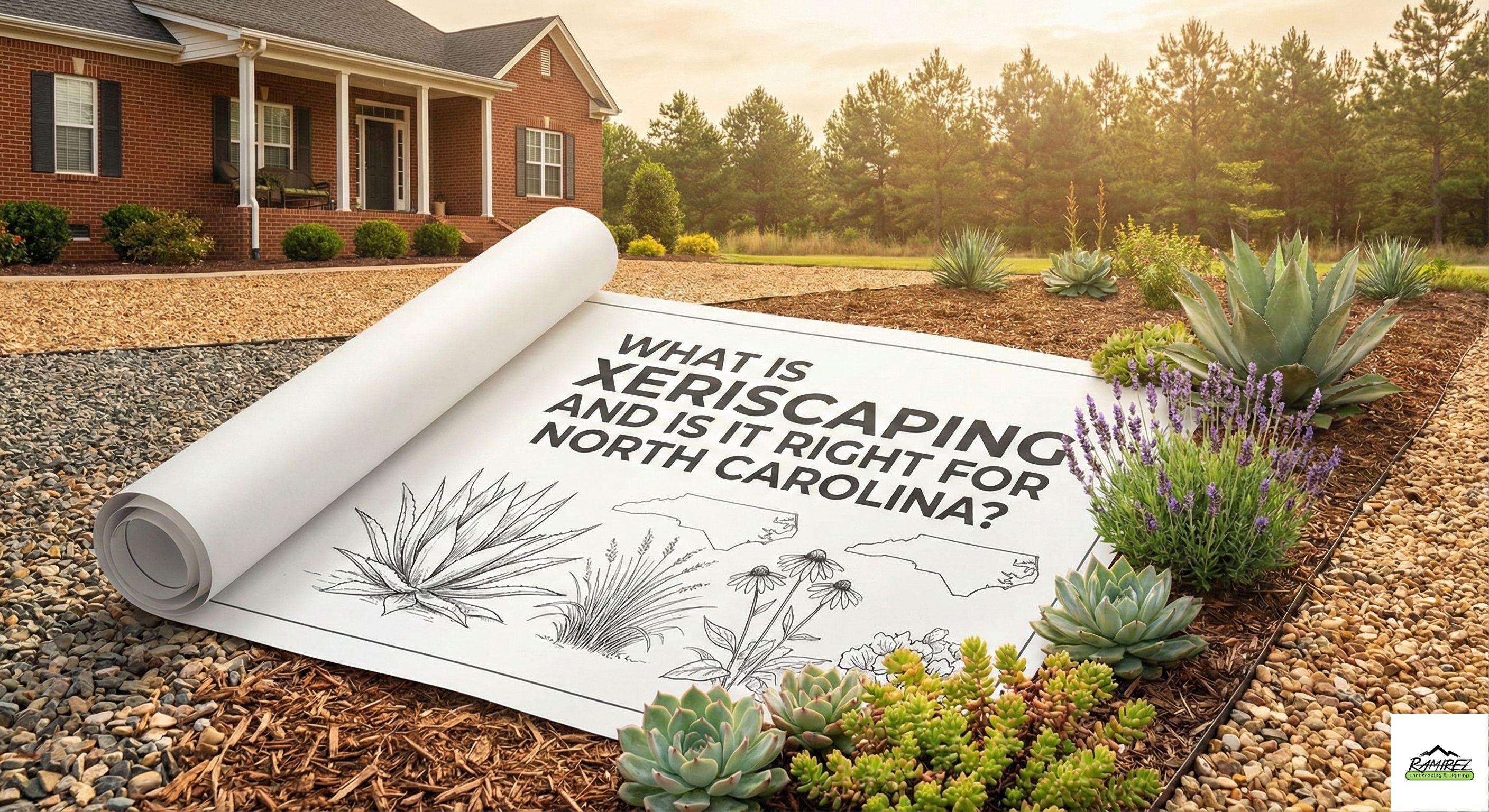
What is xeriscaping and is it right for North Carolina?

Get a FREE Design Consultation! ($500 Value - Limited Time)
Get in touch for a free consultation and estimate

Yes, xeriscaping is exceptionally well-suited for North Carolina, but not in the way most people think. It's not about creating a desert-like yard with rocks and cacti. Instead, successful North Carolina xeriscaping involves a sophisticated approach to landscape design that uses beautiful, water-wise native plants to create a lush, resilient garden that thrives in our state's unique climate of heavy rainfall followed by periods of intense heat and drought, ultimately reducing maintenance and water usage.
The Great North Carolina Landscaping Puzzle: Thriving in the "Water Whiplash"
Living in North Carolina means embracing a climate that can’t quite make up its mind. We enjoy beautiful, temperate weather for much of the year, but our landscapes are constantly challenged by what I call the "NC Water Whiplash." One month, we're navigating torrential downpours from a summer storm system that super-saturates our infamous red clay soil. The next, we're facing a string of 95-degree days with no rain in sight, baking that same clay into something resembling concrete. This cycle of extremes—from deluge to drought—is the central challenge for any North Carolina homeowner trying to maintain a healthy, beautiful yard.
A traditional turfgrass lawn, the default for many subdivisions, is particularly vulnerable to this whiplash. During wet periods, the dense, compacted clay soil struggles with drainage, leading to fungal diseases, root rot, and muddy patches. When the pendulum swings to drought, that same lawn requires an immense amount of water to stay green. Homeowners find themselves in a constant battle, running sprinklers and increasing their water bills just to keep their grass from turning brown and dormant. This reactive approach to landscaping is not only expensive and time-consuming but also fundamentally at odds with our local environment. It's a high-input system that demands constant intervention. The core question becomes: is there a smarter way to work with our climate instead of fighting against it?
What is Xeriscaping, Really? Debunking the "Zero-scape" Myth
When most people hear the word "xeriscape," their minds immediately picture the stark, arid landscapes of Arizona or Nevada: vast expanses of gravel, a few lonely cacti, and maybe a bleached cow skull for effect. This is the single biggest misconception holding North Carolina homeowners back from a more sustainable and beautiful landscape. This desert-style design is more accurately called "zeroscaping," a term that implies a near-total elimination of plant life. That is not what we’re talking about here.
The term "xeriscape" comes from the Greek word xeros, meaning "dry." It’s a set of water-conservation landscaping principles, not a specific aesthetic style. The goal of xeriscaping is to create a beautiful, functional landscape that requires minimal supplemental irrigation once established. In a temperate, humid climate like ours, this doesn't mean eliminating plants; it means choosing the right plants and supporting them with smart design. A proper North Carolina xeriscape is vibrant, full of color and texture, and buzzing with pollinators. It features flowering perennials, graceful ornamental grasses, and sturdy shrubs and trees that are native or well-adapted to our region. It’s a landscape designed for resilience.
The confusion between xeriscaping vs zeroscaping is understandable, but the distinction is critical. Zeroscaping prioritizes the elimination of water use above all else, often at the expense of ecological value and aesthetic appeal. A true xeriscape balances water conservation with the creation of a healthy, living ecosystem. For homeowners here, this is why xeriscaping is important: it offers a direct solution to the NC Water Whiplash, creating a garden that can handle both the rainy seasons and the inevitable dry spells with grace.
Smart Scaping Techniques: The 7 Principles of Xeriscaping Adapted for North Carolina
The foundation of a successful xeriscape lies in seven core principles. While these principles are universal, their application must be tailored to our specific regional challenges—namely, heavy clay soil, high humidity, and periods of intense rain. A skilled professional, whether a local landscape architect or an experienced Greensboro NC xeriscape designer, understands how to adapt these principles to the unique microclimate of a property.
1. Comprehensive Planning and Design
A resilient landscape doesn't happen by accident. The first step is to create a thoughtful plan. This involves analyzing your property to understand its unique conditions: sun exposure, shady areas, natural slopes, and existing features. A proper design groups plants with similar water and light needs together, creating "hydrozones." For instance, plants that need slightly more moisture can be placed in a lower-lying area that naturally collects more runoff, while true drought-tolerant species are sited in the sunniest, driest spots. This is the essence of a low-water garden design. A modern xeriscape design also incorporates hardscaping elements like paths and patios from the very beginning, ensuring a cohesive look that blends beauty with function.
2. Critical Soil Improvement
This is arguably the most important principle for success in the North Carolina Piedmont and beyond. Most of us are dealing with heavy, compacted red clay soil. While rich in some nutrients, clay has poor drainage. During heavy rains, it becomes waterlogged, starving plant roots of oxygen. During a drought, it hardens into brick. The key is amending clay soil for drainage. The process of how to xeriscape NC clay soil always begins with incorporating vast amounts of organic matter—compost, pine bark fines, or aged manure—into the top 6-12 inches. This improves soil structure, creating air pockets that allow water to penetrate and roots to breathe. Improving garden soil drainage is not a one-time fix; it's a long-term commitment to building healthy, living soil that acts like a sponge, holding moisture during dry spells and allowing excess water to drain away during wet ones.
3. Appropriate Plant Selection
The heart of a vibrant North Carolina xeriscape is its plant palette. Instead of relying on thirsty imports, we lean into the incredible diversity of North Carolina native plants and other well-adapted species. These are plants that have evolved for generations in our climate. They are naturally equipped to handle the summer heat, humidity, and periodic drought. When you choose native perennial plants for NC xeriscape, you are selecting plants that are already programmed for success. We will explore a detailed plant list later, but the focus is on species that provide year-round interest xeriscape garden appeal, support local wildlife, and require little to no supplemental water once established.
4. Practical and Limited Turf Areas
Xeriscaping doesn't mean you have to rip out your entire lawn. It encourages a more thoughtful use of grass. Instead of a "wall-to-wall carpet" of turf, consider where you actually need it for recreation, pets, or play. In other areas, you can introduce beautiful lawn alternatives for North Carolina, such as creeping ground covers, beds of ornamental grasses, or gravel paths. By reducing the size of your lawn, you dramatically cut down on mowing, fertilizing, and, most importantly, watering. This is a key strategy for reducing your water bill with landscaping without sacrificing the utility of your outdoor space.
5. Efficient and Minimal Irrigation
The goal of a mature xeriscape is to survive on natural rainfall alone. However, all new plants need water to get established. Even the most drought-tolerant plants require regular watering during their first year. As researchers at The Spruce have noted, even drought-tolerant plants like Catmint (Nepeta spp.) and Giant Hyssops (Agastache foeniculum) require frequent or weekly watering during their first year to become established. The key is to deliver this water efficiently. Drip irrigation NC systems and soaker hoses are far superior to overhead sprinklers, as they deliver water directly to the plant's root zone, minimizing evaporation and runoff. For our region's soil, it's about finding efficient irrigation systems for clay soil, which often means applying water slowly over a longer period to allow it to soak in rather than run off the surface.
6. The Strategic Use of Mulches
Mulch is a xeriscaper's best friend. A 2-3 inch layer of organic mulch, such as triple-shredded hardwood or pine bark, serves multiple functions. It suppresses weeds, moderates soil temperature, prevents erosion, and, most critically, slows the evaporation of moisture from the soil. As the organic mulch breaks down, it further enriches the soil. While decorative rocks and gravel can be used as a mulch in certain applications, like a rock garden or around succulents, organic mulches are generally the best mulch for North Carolina gardens because they actively improve our clay soil over time.
7. Appropriate, Low-Impact Maintenance
Low-maintenance is not "no-maintenance." A xeriscape landscape still requires care, but the tasks are different and often less frequent than those for a traditional lawn. A proper xeriscape maintenance guide would include tasks like seasonal pruning to maintain plant shape and health, occasional weeding (greatly reduced by mulch), and replenishing mulch every year or two. The trade-off is significant: you are replacing hours of weekly mowing, edging, and fertilizing with more mindful, periodic gardening tasks.
Curating the North Carolina Xeriscape Palette: Beyond Black-Eyed Susans
Choosing the right plants is the most exciting part of creating a xeriscape. While classics like Coneflowers (Echinacea) and Black-eyed Susans (Rudbeckia) are fantastic, a truly stunning landscape explores the wider array of species that thrive here. When planning, it's helpful to consider plants in layers, from towering trees to low-growing ground covers, to create a garden with structure and year-round appeal.
Drought-Tolerant Trees for North Carolina
Trees are the backbone of a landscape, providing shade, structure, and habitat. Many of our native oaks, hickories, and pines are extremely drought-tolerant once established. For a flowering option that provides stunning summer color, few can beat the Crape Myrtle. It's a perfect fit for our region, as Crape Myrtle (Lagerstroemia indica), a flowering tree that can grow up to 30 feet, is suitable for NC's hardiness zones (6-9) and, according to the North Carolina Extension, it 'resists deer, drought and pollution.' Other excellent choices include Eastern Red Cedar (Juniperus virginiana), a tough native evergreen, and the American Holly (Ilex opaca).
Drought-Tolerant Shrubs for the Southeast
Shrubs add a critical mid-layer to the garden. Instead of thirsty azaleas in full sun, consider options like Beautyberry (Callicarpa americana), which offers delicate summer flowers followed by spectacular clusters of purple berries in the fall. Oakleaf Hydrangea (Hydrangea quercifolia), a native, performs beautifully in part-shade and offers four seasons of interest with its large flowers, deep red fall color, and peeling cinnamon-colored bark. For sunny, dry spots, Adam’s Needle (Yucca filamentosa) provides dramatic architectural form and towering spikes of white flowers.
Perennial Plants and Ornamental Grasses for Sun
This is where you can truly paint with color and texture. Answering what plants survive NC summer heat is easy when you look to natives. Plants like Butterfly Weed (Asclepias tuberosa) offer brilliant orange blooms and are a critical food source for monarch caterpillars. Aromatic Aster (Symphyotrichum oblongifolium) explodes with purple flowers in the fall, providing a vital late-season nectar source for pollinators. Indeed, a common question is, does xeriscaping attract pollinators? The answer is a resounding yes, especially when you prioritize native species. Graceful ornamental grasses for NC sun like Little Bluestem (Schizachyrium scoparium) and Pink Muhly Grass (Muhlenbergia capillaris) add movement and texture, with the latter putting on an unforgettable show of hazy pink plumes in the fall.
Low Water Ground Cover for NC
When asked what is the best ground cover in North Carolina, the answer depends on the situation. For a tough, evergreen, flowering ground cover in a sunny spot, few can beat Creeping Phlox (Phlox subulata), which forms a dense mat covered in flowers in the spring. For shadier, drier spots—a common challenge under large trees—consider Green and Gold (Chrysogonum virginianum), a native that offers cheerful yellow flowers over a long season. These alternatives to turfgrass can beautifully fill in spaces, suppress weeds, and reduce the need for mowing.
A Note on Succulents and Cacti
So, can you grow succulents outdoors in NC? Yes, but with careful selection. Our wet winters are a bigger threat to most succulents than our cold temperatures. While we can’t grow the iconic Saguaro cactus, we can successfully cultivate cold-hardy species like certain types of Sedum and Hens-and-Chicks (Sempervivum). It is important to remember that a cactus is a type of succulent, which is defined as a plant that can store water in its stems and leaves, making it a common choice for true desert landscapes. For our climate, they must be planted in exceptionally well-draining soil, often in raised beds or rock gardens, to prevent root rot during our rainy seasons.
Designing for Beauty and Function: Hardscaping and Layouts
A successful xeriscape is more than just a collection of drought-tolerant plants. The "bones" of the garden—the hardscaping and layout—are what tie everything together and ensure long-term functionality. This is where smart design principles elevate a simple garden into a sophisticated landscape.
The use of hardscaping with native stone, like the beautiful and varied stone quarried in our state, can create retaining walls, patios, and walkways that feel perfectly at home in the North Carolina landscape. Thoughtful xeriscaping with gravel paths can create informal, permeable walkways that guide you through the garden while allowing rainwater to soak into the ground. When choosing rocks for your xeriscape, consider both color and texture to complement your home's architecture and your plant choices.
For homeowners with sloped properties, xeriscaping on a slope in NC is a powerful tool for erosion control. Terracing with stone walls and planting the levels with deep-rooted native plants and grasses can stabilize the soil and turn a challenging hillside into a stunning feature. Thoughtful grading and the use of permeable pavers NC for driveways and patios also play a crucial role. These materials allow stormwater to filter through into the soil, recharging groundwater and reducing the strain on municipal storm drains during our heavy downpours. Rock garden ideas for NC can be particularly effective on slopes, creating pockets for alpine-style plants that demand sharp drainage. The overall layout, from a complete backyard xeriscape ideas overhaul to xeriscaping a front yard in North Carolina for curb appeal, should always prioritize a seamless flow between planted areas and functional hardscaped spaces.
The Financial and Environmental Equation: Answering Your Biggest Questions
Switching to a water-wise landscape is a significant decision, and it’s natural to have questions about the cost, value, and potential downsides. Let's break down the key factors that influence this choice.
Key Decision Factors: Traditional Lawn vs. NC-Adapted Xeriscape
Aesthetic Preference
Traditional Lawn: Offers a uniform, manicured green carpet. The look is classic and neat, but can be monotonous and lacks seasonal variation.
NC-Adapted Xeriscape: Provides a dynamic, naturalistic aesthetic with a huge variety of colors, textures, and forms. It offers year-round interest as different plants bloom and change with the seasons. The style can range from a tidy, modern xeriscape design to a more cottage-like or meadow-inspired look.
Water Conservation and Utility Costs
Traditional Lawn: Extremely high water demand during summer and drought periods to remain green. This directly leads to higher municipal water bills and puts a strain on local water resources, potentially leading to issues during periods of water restrictions and landscaping NC mandates.
NC-Adapted Xeriscape: Significantly lower water use. Once established (after the first year), a well-designed xeriscape can thrive on natural rainfall alone, drastically reducing or eliminating landscape irrigation costs. As noted by experts at This Old House, low-water gardening, also known as xeriscaping, can reduce water consumption, lower utility bills, and minimize maintenance time and effort. The use of rain barrels further enhances water conservation efforts, and the benefits of xeriscaping in NC are most clearly seen in your summer utility bills.
Long-Term Maintenance Requirements
Traditional Lawn: A constant cycle of high-labor tasks: weekly mowing, edging, fertilizing multiple times a year, aerating, and applying herbicides and pesticides. It is a relentless, repetitive workload.
NC-Adapted Xeriscape: The labor is front-loaded. After installation, maintenance shifts to more periodic tasks: refreshing mulch annually, occasional weeding, and seasonal pruning or cutting back of perennials. It eliminates the weekly grind of mowing.
Plant Resilience to Local Climate
Traditional Lawn: Highly susceptible to the "NC Water Whiplash." It struggles with fungal diseases in wet, humid weather and goes dormant or dies during summer droughts without heavy irrigation.
NC-Adapted Xeriscape: Specifically designed for resilience. Native and adapted plants can handle both periods of soil saturation and extended dry spells. The improved soil structure helps manage excess water, and the drought-tolerant nature of the plants ensures they survive the summer heat.
Frequently Asked Questions About Xeriscaping in North Carolina
Beyond the direct comparisons, homeowners often have specific concerns. Let's address some of the most common ones.
What is the downside of Xeriscape?
The primary downsides are the initial investment and the establishment period. A full xeriscape installation North Carolina project, which can include soil amendment, new plants, mulch, and potentially hardscaping, will have a higher upfront cost than simply laying sod. The cost of xeriscaping in Charlotte NC or near Raleigh can vary, but it's an investment in future savings. Additionally, the landscape will take one to two years to mature and fill in, requiring more diligent watering and weeding during this initial phase before it becomes truly low-maintenance.
Does xeriscaping decrease property value?
This is a persistent myth. A poorly executed, weedy, or barren landscape of any kind will decrease property value. However, a professionally designed and well-maintained xeriscape often increases property value. It boosts curb appeal with its lush, multi-seasonal interest and is a significant selling point for buyers who are increasingly interested in sustainable landscaping practices and lower utility bills. A beautiful landscape without a lawn is a feature, not a flaw.
Is xeriscaping cheaper than grass?
It's a matter of short-term vs. long-term costs. The initial installation cost of xeriscaping is typically higher than a traditional lawn. However, over a period of 3-5 years, the savings on water, fertilizer, pesticides, and lawn equipment (or lawn service fees) can allow the xeriscape to pay for itself. From that point forward, it represents a significant annual saving, making it much cheaper in the long run.
What is the most invasive plant in North Carolina?
This is an important consideration, as the goal of a sustainable landscape is to support, not harm, the local ecosystem. While there are many invasive species, plants like English Ivy, Bradford Pear, Nandina, and Wisteria are notoriously aggressive. They escape cultivation, choke out native plants, and disrupt the food web. A core tenet of good xeriscape design is to avoid these invasive species and instead use North Carolina native plants that provide food and habitat for local wildlife without becoming an ecological problem.
Making the Right Choice for Your Needs
The decision to embrace a xeriscape landscape is personal. The best choice depends entirely on your goals, your property, and your lifestyle. Here is some tailored advice for different types of homeowners.
For the Eco-Conscious Homeowner
If your primary goal is to reduce your environmental footprint, a xeriscape is the ideal choice. By focusing on a diverse palette of North Carolina native plants, you can create a landscape that provides crucial habitat and food for local pollinators, birds, and other wildlife. You'll be actively conserving water, a precious resource, and eliminating the need for chemical fertilizers and pesticides that can pollute our local waterways and the Haw river system. This is the ultimate expression of sustainable landscaping practices, creating a yard that is not just beautiful but also an ecological asset.
For the Low-Maintenance Seeker
If your weekends are precious and the thought of another Saturday spent behind a lawnmower fills you with dread, a xeriscape offers a clear path to freedom. While it requires an initial investment of time and money to install correctly, the long-term payoff is a dramatic reduction in weekly yard work. Your maintenance will shift from a constant battle to keep grass alive to occasional, more enjoyable tasks like pruning and watching your garden mature. This approach allows you to spend more time enjoying your outdoor space and less time working in it.
For the New NC Resident
If you've recently moved to North Carolina, you may be unfamiliar with the challenges of our heavy red clay soil and unpredictable weather patterns. Fighting this climate with plants and landscaping styles from your previous home can be a frustrating and expensive experience. A xeriscape, designed with plants proven to thrive here, is your surest bet for success. It removes the guesswork and provides a resilient, forgiving landscape that is built to handle the local conditions. It's the smartest way to ensure you have a beautiful yard that flourishes from day one, without the steep learning curve of a traditional garden.
The journey to a smarter, more resilient landscape begins with understanding that in North Carolina, water-wise doesn't mean barren. It means embracing the lush, vibrant beauty of our native flora. By working with our unique climate instead of against it, we can create stunning outdoor spaces that are not only easier to maintain and less expensive to keep, but also truly reflect the natural elegance of our state.
At Ramirez Landscaping & Lighting, we've dedicated over two decades to mastering the art and science of creating beautiful, sustainable landscapes that thrive in our specific climate. Based in Greensboro, NC, we bring unparalleled local expertise to every project, from sophisticated design and meticulous installation to long-term maintenance. If you're ready to transform your yard into a resilient, low-maintenance oasis, contact our team of experts today for a personalized consultation and a complimentary quote.