

What should I consider before building a retaining wall?

Get a FREE Design Consultation! ($500 Value - Limited Time)
Get in touch for a free consultation and estimate

Before building a retaining wall, you must consider that it is an active structural system, not a passive garden feature. Success depends on a design that manages immense soil and water pressure. Key factors include a proper foundation, an integrated drainage system, and reinforcement to prevent sliding or overturning failure.
When homeowners envision a new retaining wall, their minds often jump straight to the aesthetics—the texture of the natural stone, the clean lines of interlocking concrete blocks, or how new integrated stairs will connect their lawn to a patio. But as a professional who has designed and repaired these structures for over two decades, I can tell you that what you see is the least important part.
A retaining wall is more than a decorative element; as engineering guidelines define it, a retaining wall is a structure designed to support a differential height of earth on either side or retain earth laterally. The most critical work happens underground and behind the wall, where an invisible battle against physics is constantly being waged.
Most common building mistakes stem from a single misunderstanding: focusing on the wall itself instead of the forces it's meant to control. A successful project is less about stacking materials and more about engineering a defense against failure.
Thinking Like an Engineer: It's Not a Wall, It's a Soil Retention System
The first step is to change your vocabulary and your mindset. You don't just want a wall; you need a "soil retention system." This shift correctly frames the project's primary function. The wall face is merely the visible component of a larger system that includes a foundation, drainage, and often, soil reinforcement.
The design of this system is dictated by site-specific conditions. Before a single block is laid, a thorough site assessment is crucial. This involves analyzing the slope and grade, understanding the soil type, and planning for any weight the wall must support from above—what we call a surcharge load—like a driveway, patio, or even just a steeply sloped lawn. A professional land survey is often the first step to accurately map property lines and topography.
From there, a key decision at the beginning of a retaining wall design is whether the site is better suited for 'top-down construction' (excavating) or 'bottom-up construction' (filling). This choice depends entirely on your existing landscape and what you want to achieve.
Every site is unique, which is why we don't use a cookie-cutter approach. A landscape design must account for these variables. We want to avoid pre-baked solutions, as no two properties have the same soil, drainage patterns, or functional needs. Your local soil conditions, whether sandy loam or expansive clay like some found in Colorado, will dramatically influence the design requirements.
The Anatomy of Failure: 3 Ways Retaining Walls Collapse
Wall failure risks are real, and they almost always fall into one of three categories. Understanding these potential failure modes helps clarify why certain construction steps are absolutely non-negotiable. Many of the building permits and zoning regulations for walls are in place specifically to prevent these issues.
Sliding Failure
This occurs when the lateral earth pressure behind the wall is great enough to push the entire structure forward along its base. It simply slides away from the hill it's supposed to hold back. This is a common failure with DIY considerations, where the base preparation is often inadequate.
To prevent it, a wall needs a proper foundation and footing dug below the frost line depth, built on compacted, undisturbed native soil or a dense gravel base. The weight of the wall itself and the friction between its base and the ground are the primary defenses against sliding.
Overturning Failure
Overturning is exactly what it sounds like: the wall topples over, rotating from its base. This happens when the pressure on the upper portion of the wall overwhelms its ability to stay upright. The two main tools to fight this are wall batter and reinforcement.
Wall batter (setback) is the slight backward lean of the wall into the hillside. Each course of a segmental retaining wall (SRW), for example, is set back slightly from the one below it. This small adjustment shifts the wall's center of gravity, making it significantly more stable.
For taller walls, geogrid reinforcement—a strong, flexible mesh—is laid in horizontal layers from the wall back into the soil, effectively anchoring the wall to the very earth it's retaining.
Global Stability Failure
This is the most complex type of failure, where the soil mass around and even under the wall gives way. It's a deeper, more catastrophic collapse of the entire slope. While less common for residential landscape walls under four feet, it becomes a serious consideration on sites with steep slopes, weak soil, or poor water management. This is a scenario where consulting a structural engineer is not just a good idea—it's an absolute necessity for safety.
The Hidden Killer: Why Water Is Your Wall's Worst Enemy
If soil is the opponent, water is the weapon that makes it powerful. The weight of dry soil is significant, but saturated soil is a different beast entirely. The pressure exerted by trapped water is called hydrostatic pressure, and it is the single most destructive force acting on retaining walls.
Consider that a modest four-foot-high, 15-foot-long wall could be holding back as much as 20 tons of saturated soil. Without a path to escape, that water will find a way out, and it will usually take the wall with it, especially during intense freeze-thaw cycles.
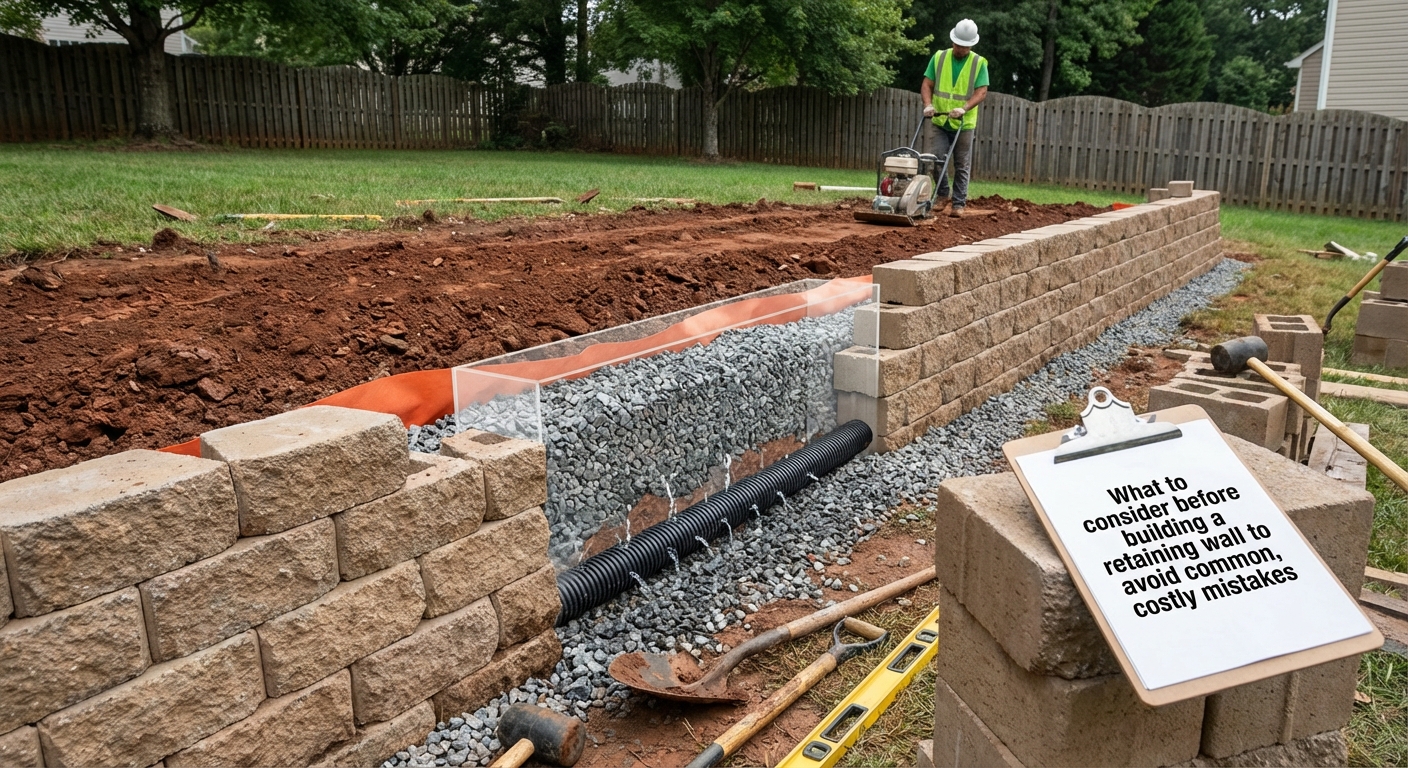
This is why proper drainage is not an optional add-on; it is the heart of a durable retaining wall. A comprehensive water management system must include:
Gravel Backfill: A column of clean, crushed stone (at least 12 inches wide) is placed directly behind the wall. This creates a porous zone where water can freely flow downward instead of pressing against the wall face.
Drain Pipe: A perforated pipe is placed at the bottom of the gravel zone to collect the water and channel it away from the wall's base, exiting at the ends of the wall or through weep holes.
Geotextile Fabric: This special fabric separates the gravel backfill from the surrounding soil, preventing dirt and silt from migrating into the drainage zone and clogging it over time.
Building Beyond the Basics: The Professional's Approach
When you hire a contractor, you're paying for their expertise in managing these forces. Professionals design not just to meet the expected load, but to exceed it by a significant margin. This concept is called the "Factor of Safety."
It is a core engineering principle where walls must be checked to ensure minimum factors of safety are met for all potential modes of failure, including sliding and overturning. A typical Factor of Safety is 1.5, meaning the wall is designed to be 50% stronger than the maximum calculated forces acting against it.
Achieving this requires choosing the right wall type for the job. A simple gravity retaining wall made of massive stones might work for a short, decorative garden wall. However, for most applications, a segmental retaining wall system using high-quality interlocking concrete blocks from manufacturers like Allan Block or Keystone Hardscapes offers a superior, engineered solution, especially when combined with geogrid reinforcement.
Other options, like a cantilevered retaining wall of poured concrete or even a gabion wall (wire cages filled with rock), have specific applications where they excel. The material costs and labor costs associated with each will vary, affecting the final cost per square foot, but the choice should always be driven by engineering needs first.
Before any excavation requirements begin, it's critical to check with your local municipality about building codes and whether a permit is needed. And always, without exception, call 811 to have public utility lines marked on your property. Hitting a gas or electric line is a dangerous and costly mistake.
Making the Right Choice for Your Needs
The "best" retaining wall doesn't exist. The right wall is the one that safely and effectively solves your specific problem while meeting your aesthetic goals and budget. Here is how to choose based on your primary motivation.
For the Aesthetic-Focused Homeowner
Your main concern is how the wall will look and integrate with your overall landscape design. You might be drawn to the beauty of natural stone or the variety of colors and textures available in concrete products like those from Colorado-based manufacturers.
Your task is to balance that vision with structural reality. Work with a designer or landscape architect who can help you select materials that not only look great but are appropriate for the height and load of your wall. Ensure your plan includes details for wall caps, hardscape integration, and proper drainage, so your beautiful investment doesn't become a leaning eyesore in a few years.
For the Problem-Solver Property Owner
You have a pressing need: erosion control, a collapsing hillside, or a drainage issue threatening your foundation. For you, functionality is paramount.
Your best course of action is to partner with an experienced contractor who can diagnose the root cause of your problem. They will focus on engineering a robust solution first—be it a single tall wall, a series of terraced walls, or a gravity wall. The materials and appearance are secondary to creating a system that provides long-term property protection and peace of mind.
For the DIY Enthusiast
You are focused on minimizing labor costs and have the drive to tackle the project yourself. The most important advice is to know your limits.
Building a small, decorative garden wall under two feet is a manageable DIY project. Anything taller exponentially increases the forces and failure risks. If you proceed, invest your time in research. Understand base preparation, compaction, and drainage principles. Rent the proper equipment. Never underestimate the sheer physical labor involved in moving tons of block, gravel, and soil. Avoid the common mistakes we saw so often in 2025 where homeowners skipped the gravel backfill or failed to compact the base properly.